Table of Contents
- Patient experience
- How ER Express' matching algorithm works
- "Default" insurance
- Insurance package ID vs insurance package name
- Insurance card image
- Top and common insurance
- Superpackages
- Self-pay, Worker's comp, prompt pay, and other policies
Patient experience
- During the intake workflow, the ER Express will ask patients for insurance only if their visit type warrants it. For example, patients presenting for an employer-paid physical will NOT be asked for their insurance information.
- If ER Express identifies the patient as a returning patient, it will look up her primary and secondary insurance, show the patient, "here is what we have on file for you" and ask if she wants to use the insurance on file.
- If the patient answers yes, then she does not have to input her insurance information or take a picture of the insurance card.
- If the patient is new OR does not have insurance on file OR chooses to add new insurance, ER Express will then ask for:
- Insurance name, e.g., Blue Cross Blue Shield PPO, Aetna
- Member ID
- Policy ID (optional)
- Front of insurance card
- Back of insurance card
- We recommend giving patients the option to proceed without providing an image. Some patients have difficulty uploading a picture or do not have it with them.
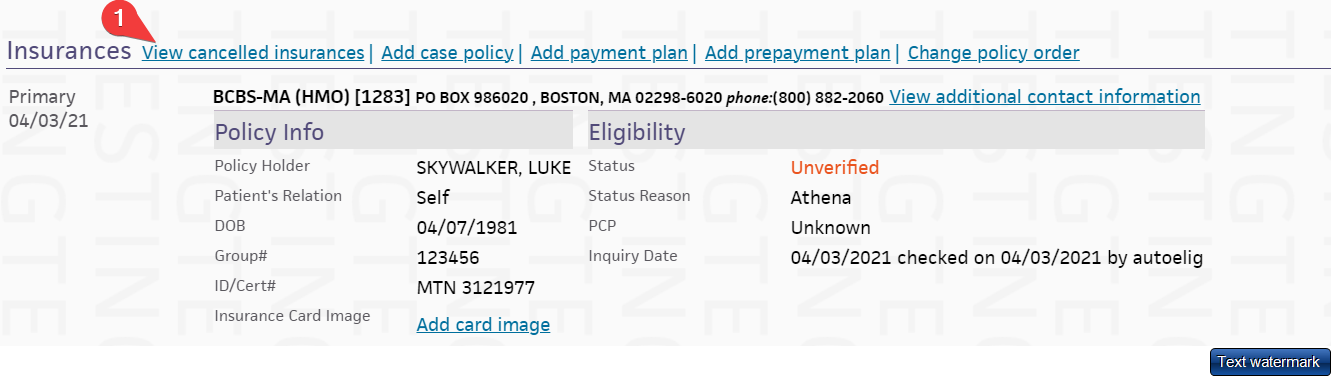
- If patients choose to replace the existing primary insurance on file, ER Express will make the new insurance their primary insurance and de-activate (NOT delete) the existing insurance. Clinic staff can still see and re-activate deactivated packages by clicking on 'View cancelled images.'
Example of where to click:
How ER Express' matching algorithm works
- ER Express matches each patient's input and then makes a probabilistic match based on the most frequently used insurance packages that each practice AND department use
- In the patient-facing intake form, ER Express will auto-suggest insurance packages as the patient types; the auto-suggestions are also based on the most frequently used insurance packages.
- For example, as a patient starts tying, "blue cross ppo..." the auto-suggester will suggest several possibilities, including, "BCBS - PPO" and "BCBS - PPO (Medicare/Advantage."
- Patients do NOT have to accept the auto-suggestion and can simply free-text type in their insurance.
- ER Express' algorithm accounts for misspellings and variations and commonly used terms. For example, although many patients will type in "Blue Cross Blue Shield..." the actual name in athena always used "BCBS..."
- ER Express uses an extensive ranking methodology to "tie-break" based on the frequently used insurance packages. This data set is refreshed nightly and is specific to each department, reflecting that the most commonly used packages vary considerably by state and ZIP code. For example, the eastern part of Tampa, FL may have a different employer base than the western half, and thus have more patients that use Aetna. The western part of Tampa may be near a military base and therefore have more patients using Tri-care.
- Whenever possible, ER Express will select the exact match insurance package.
Other Factors / Limitations
- ER Express does NOT explicitly ask for the insurance "product type" e.g., HMO, PPO. We have tested it and patients have very low accuracy in knowing what it means. They can of course input it and ER Express will factor it into the match.
- ER Express does not ask for the insurance phone number or address. Similarly, we have tested it and patients have very low accuracy in knowing whether to input the claims address or the customer service address. Additionally, as more carriers move to digital instead of physical cards, they do not always provide a "back" image, so patients do not always have the insurance carrier's address or phone number.
Default insurance
ER Express strongly recommends that each practice create a "default" insurance package so that in the event that our algorithm cannot find a match that meets our confidence level, it can still post the insurance information, such as the member ID.
The default insurance package, while best practice, is not mandatory.
Insurance package ID vs insurance package name
- athena assigns each insurance package a numeric identification number. ER Express will post this numeric identifier in order to reflect that the actual descriptive names can vary by region and state or even get renamed from time to time by the carriers (e.g., Aetna Signature becomes Aetna Select).
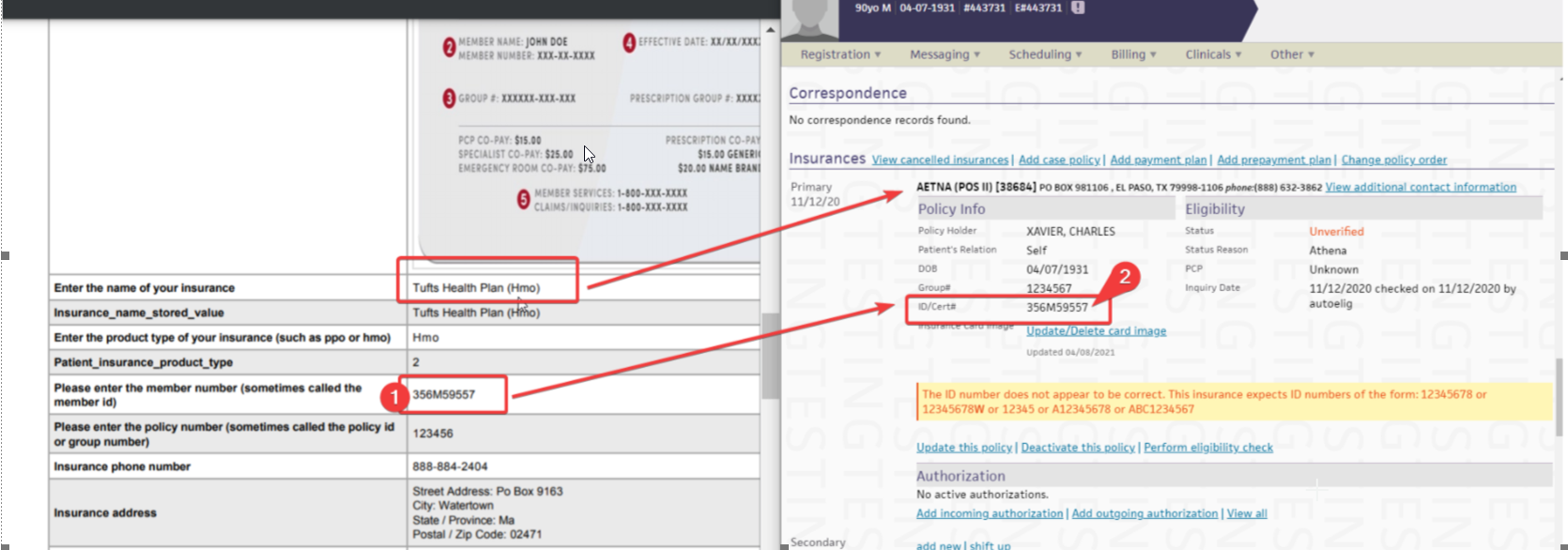
- Similarly, if the patient enters a member ID that matches against an existing member ID, ER Express will select this package even if the name differs. This accounts for situations where patients make mistakes in entering their insurance but enter the correct memberID, which is the single field that they are most likely to get right since it is clearly identifiable and if it has not changed, they very likely have the same insurance package.
Insurance card image
- ER Express will upload the insurance card front and back image to the Quickview
- Important: the clinic's registration staff still MUST review the insurance package selection for accuracy.
- ER Express does NOT run eligibility checks.
Top and common insurance
- ER Express updates each department's most frequently used insurance packages each night.
- This process accounts for changes in naming conventions, open enrollment periods, insurance carriers entering/exiting the market, etc.
- If your practice or department has additional insurance packages, ER Express will happily load them manually. Just provide a spreadsheet with the insurance package name and package ID.
- If your practice is new to athena, depending on your migration process (e.g., from paper or from a different PM system), it may take 2-3 months for ER Express' algorithm to "learn" which package to select.
Superpackages
- Many practices create "superpackages" to roll up common variations into a single consolidated package.
- For example, all commercial Blue Cross packages typically roll up into the commercial package for the state in which the patient receives care.
- For example, a patient with BCBS-GA presents at a clinic in Ohio. The patient's claim will get submitted to BCBS-OH, so ER Express will map all BCBS commerical packages to BCBS-OH for all departments located in Ohio.
- For example, if a patient presents with Priority Health Choice, ER Express can map this package to Priority Health (Medicaid Replacement-HMO).
- ER Express can easily accommodate state-specific superpackages.
- ER Express can often, but not always, accommodate packages within states.
- ER Express can create superpackage rules based on geography and the name of the insurance carrier and product. However, it cannot interpret images. For example, UnitedHealthcare has a package that should get submitted to its Arkansas claims address if the Oxford logo appears on the front of the card. ER Express cannot distinguish the presence of logos, colors, etc.
- ER Express cannot factor in other exogenous factors, such as whether a TriCare member is on active duty, or whether the patient lives in the Tricare East or Triacare West region.
Self-pay, Worker's comp, prompt pay, and other policies
- ER Express does allow for patients to input "self pay" and will submit and match against the self-pay package, which for many practices is one of the most frequently used packages.
- ER Express does NOT post insurance policies. Although some practices will label self-pay and prompt-pay as packages, they are in fact policies. Matching against policies is currently outside of ER Express' scope.
- Similarly, ER Express does NOT post workers' comp packages and policies.